











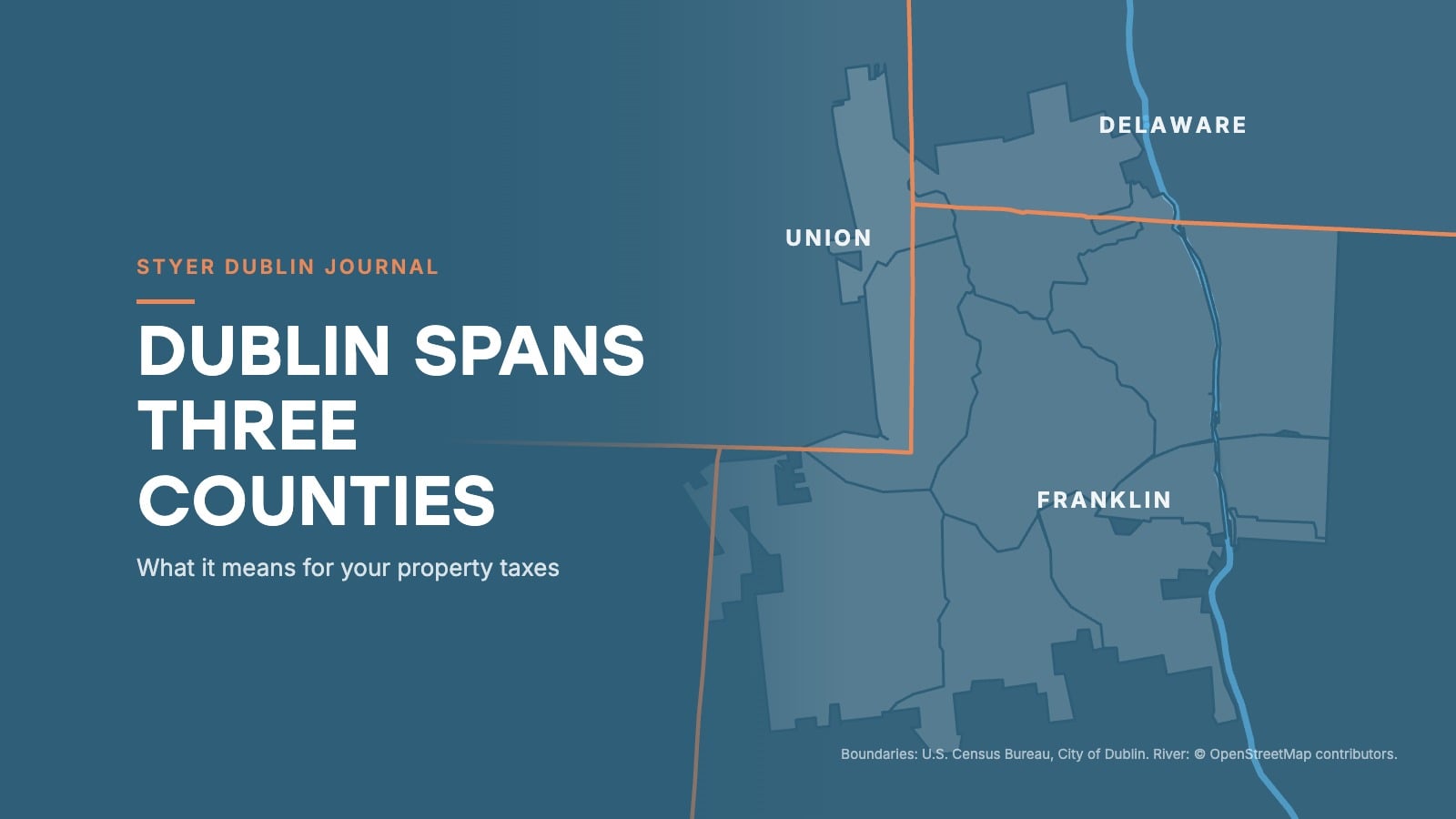
The City of Dublin includes land in three counties, Franklin, Delaware, and Union. That matters when you compare homes. Two houses a mile apart, both with a Dublin address, can carry noticeably different tax bills.
The reason is not the county by itself. It is the taxing district. Below is how the system works, what the current rates look like, and how to check a specific home.
Your tax rate comes from your taxing district
In Ohio, each parcel sits in a taxing district. The district is set by the overlapping bodies that levy taxes on that land, including the county, the school district, the township, libraries, parks, and county services. Each one has its own voter-approved levies, so each combination has its own rate.
Inside Dublin’s city limits, the City of Dublin’s 2026 Resident’s Guide to Understanding Local Taxes lists seven taxing districts across the three counties. They do not all share one school district. Most of the city is in Dublin City Schools, but some areas are in Hilliard City Schools or Jonathan Alder Local Schools. The school district is the largest single piece of most bills, so it drives most of the difference.
The City of Dublin and Dublin City Schools are separate bodies with separate budgets. The City is funded mainly by income tax and receives about 3% of a resident’s property tax. Dublin City Schools is funded mainly by property tax.
The current rates by district
The City’s guide estimates a bill by dividing the market value by 1,000, then multiplying by the residential tax rate and by 0.35. The 0.35 reflects that Ohio taxes residential property on 35% of the auditor’s market value.
The guide lists these effective residential rates in mills. Next to each is our estimate for a home valued at $400,000, using that formula.
- Franklin 273 (Washington Township, Dublin City Schools), 69.76, about $9,766 a year
- Franklin 274 (Washington Township, Hilliard City Schools), 67.37, about $9,432
- Franklin 275 (Washington Township, Jonathan Alder Local Schools), 49.60, about $6,944
- Delaware 10 (Dublin City Schools), 62.12, about $8,697
- Union 185 (Washington Township, Dublin City Schools), 62.43, about $8,740
- Union 187 (City of Dublin, Dublin City Schools), 56.70, about $7,938
- Union 155 (Washington Township, Hilliard City Schools), 60.04, about $8,406
These are estimates before any credits or exemptions. Your actual bill depends on the auditor’s value for your parcel and any reductions you qualify for. The guide notes that actual taxes may be lower once those are applied.
In the guide’s own example, a $400,000 home in district 273 pays about $9,766 a year. About 64% of that goes to Dublin City Schools, about 9% to Washington Township, and about 3% to the City of Dublin, with the rest split among county services, the library, the career center, Metro Parks, and others.
What stays the same across all three counties
Some things do not change with the county line. Washington Township Fire Department provides fire and EMS service to the entire city.
The City’s 2% income tax is also the same everywhere in Dublin. For questions about your own return, call the City’s Division of Taxation at 614.410.4460.
What does change by county is who you deal with. Each county has its own auditor, who sets values and handles exemptions, and its own treasurer, who sends bills and sets due dates. In 2026, for example, Franklin County’s halves were due February 28 and July 20, while Union County’s were due February 18 and August 12. If you move from one part of Dublin to another, check the new county’s calendar.
Recent changes in Ohio law
Ohio passed several property tax bills in 2025 and 2026. Among them, H.B. 186, effective in December 2025, increased the rollback for owner-occupied homes. Other bills changed how levies and valuations are calculated. The effect on any single bill varies, so the county auditor’s site is the place to see how your parcel was treated. For questions about your own taxes, talk with your county auditor or a tax professional.
How to check a specific home
Start with the county auditor’s website for the county the parcel is in. Search by address or parcel number to see the taxing district, the auditor’s value, the current tax bill, and any reductions applied. Look at the actual bill rather than a listing estimate.
If you are buying, ask for the parcel number early and compare homes by their real bills, not just price. If you are selling, have your current bill handy. Buyers who are comparing across county lines will ask.
We keep a summary of the three-county setup on our Dublin three counties page. When you search Dublin listings, check the county and school district for each home, and use our home value page for a current read on what your own home might be worth.
Have a question about a specific home?
We work across all three of Dublin’s counties from our office at 38 N. High St., Suite 201. If you want help comparing homes in different taxing districts, contact Styer Dublin or call us at 614.502.5242.
Sources
- City of Dublin: 2026 Resident’s Guide to Understanding Local Taxes (PDF, updated February 2026)
- City of Dublin: Taxation
- Washington Township: Fire and EMS
- Washington Township: About
- Franklin County Treasurer: Property Tax Due Date FAQ
- Union County Treasurer: Payment Information
- Vorys: Ohio’s New Property Tax Legislation, Key Changes Effective March 2026 (March 17, 2026)
- Franklin County Auditor
- Delaware County Auditor
- Union County Auditor (Union County, Ohio)